In 1906 G. K. Chesterton, then a thirty-two-year-old journalist, published a book called simply Charles Dickens. Dickens had been dead for thirty-six years, and his reputation among serious critics was at a low ebb: he was thought sentimental, vulgar, exaggerated — a writer for the masses rather than for the cultivated. Chesterton’s book helped change all that. It is still one of the finest books ever written about Dickens, and it tells us almost as much about Chesterton.
Two Londoners
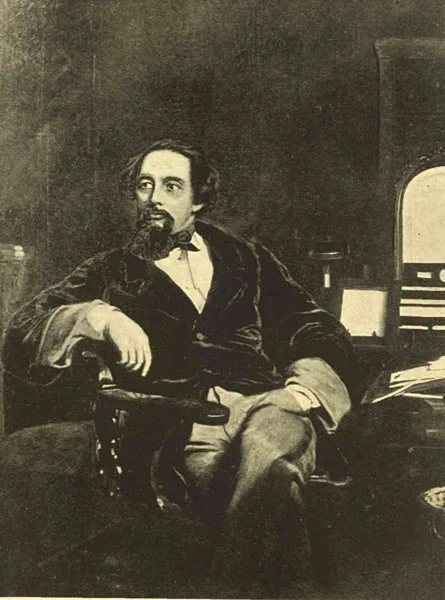
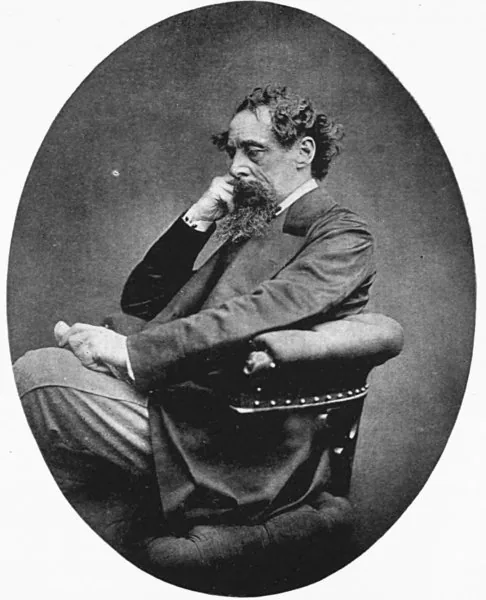
Charles Dickens was born on 7 February 1812 in Landport, Portsmouth, and grew up mostly in London. When he was twelve his father was imprisoned for debt in the Marshalsea, and the boy was sent to work pasting labels on pots of boot-blacking in a rat-infested warehouse near the Strand. He never forgot the humiliation, and he never forgot the poor among whom he had briefly lived. Within twelve years he was the most famous writer in England, after the explosive success of The Pickwick Papers (1836–37).
Chesterton, born in Kensington sixty-two years later, came from a comfortable middle-class family and never knew poverty. But he shared Dickens’s love of London streets, of inns and fogs and lamp-lit shops, and above all of ordinary people. Both men were journalists before they were novelists; both wrote at a tremendous pace; both were laughed at by critics for exaggeration; and both were, at bottom, moralists who believed that laughter and goodness belong together.
What Chesterton saw in Dickens
The central argument of Charles Dickens is that Dickens was not a realist who failed, but a mythmaker who succeeded. Critics complained that his characters were caricatures — that no one really talked like Mr Micawber or Mrs Gamp. Chesterton replied that this was exactly the point. Dickens’s characters are not photographs; they are gods and goblins of the London pavement, larger than life because life, seen with love, is larger than we usually notice. “The function of imagination,” Chesterton wrote elsewhere, “is not to make strange things settled, so much as to make settled things strange.”
Chesterton also defended Dickens’s much-mocked optimism. Dickens was not a shallow man who could not see suffering; he had seen it at twelve years old. His optimism, Chesterton argued, was the defiant cheerfulness of the poor, who laugh not because things are good but because they refuse to be beaten.
The defence of the common man
The heart of the book is a defence of democracy — not as a political system but as a spiritual attitude. Dickens, Chesterton argued, did not write down to the people or try to improve them from above; he shared their tastes, their sentiment and their sense of humour. In one of the book’s most famous lines:
Dickens did not write what the people wanted. Dickens wanted what the people wanted.— G. K. Chesterton, Charles Dickens (1906)
This is why Dickens’s attacks on social evils — the workhouse in Oliver Twist, the debtors’ prison in Little Dorrit, the cruel schools of Nicholas Nickleby, the endless lawsuits of Bleak House — were so powerful. He did not attack them as a reformer with a theory, but as an ordinary man outraged on behalf of other ordinary men. Chesterton saw in this a model for his own journalism and, later, for distributism: a politics built on the dignity of the common household rather than on the plans of experts.
The man who saved Christmas
Chesterton loved Dickens’s Christmas writing — A Christmas Carol (1843), the Christmas chapters of Pickwick — and defended it against those who found it sentimental. For Chesterton, Dickens had grasped something the Puritans and the political economists had forgotten: that human beings need feasts. Christmas was not a vague mood of goodwill but a concrete festival of eating, drinking, singing and giving, rooted in the Christian calendar. Scrooge’s conversion is not from meanness to generosity in the abstract, but from isolation to a dinner table.
Chesterton himself wrote dozens of essays and poems on Christmas, and saw in the feast an image of the whole Christian paradox: that God should be found in a stable, and that the greatest joy should come in the darkest days of the year.
Mooreeffoc: seeing the familiar as strange
In Charles Dickens Chesterton tells a small story from Dickens’s biography. As a boy, Dickens used to see the words “COFFEE ROOM” painted on the glass door of a café — and, from inside, read them backwards: MOOREEFFOC. Chesterton seized on the word as a symbol of what Dickens did for London. He made the most ordinary things — a coffee-room, a lamp-post, a pawnbroker’s shop — look as fantastic as they really are, by showing them from an unexpected angle.
The idea became central to Chesterton’s own art; it is the same impulse behind his paradoxes and his philosophy of wonder. And it travelled: J. R. R. Tolkien borrowed “Mooreeffoc” from Chesterton in his famous lecture “On Fairy-Stories”, as a name for the fresh vision that good fantasy gives back to us. You can read more about this in our article on “The Ethics of Elfland”.
The Everyman introductions
Chesterton returned to Dickens again and again. Between 1907 and 1911 he wrote introductions to each of Dickens’s books for the Everyman’s Library edition; they were collected in 1911 as Appreciations and Criticisms of the Works of Charles Dickens. Short, lively and full of insight, they make a perfect companion for anyone reading through Dickens. Chesterton also wrote about Dickens in The Victorian Age in Literature (1913), placing him at the centre of the great nineteenth-century English novel.
Poets’ Corner
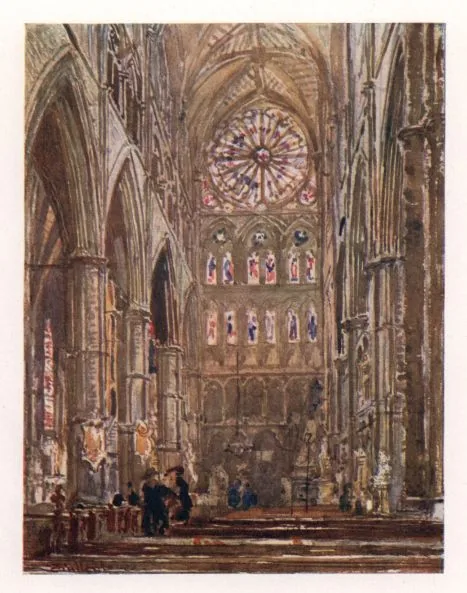
Dickens died at his home, Gad’s Hill Place in Kent, on 9 June 1870. He had asked for a simple, private burial, but public feeling was so strong that he was laid to rest in Poets’ Corner in Westminster Abbey, near Chaucer and Shakespeare’s memorial. For days afterwards thousands of people filed past the open grave, many of them poor Londoners leaving flowers. It was, Chesterton might have said, the common people claiming their own.
Dickens in Rochester, New York
Dickens has been a frequent guest at our conferences. Dale Ahlquist spoke on Dickens at our 2013 conference, Points of Light, and in 2017 Kevin O’Brien of Theater of the Word appeared as Charles Dickens at On the Shoulders of GIANTS. Both talks are free to watch on our recordings page. If you have never read Chesterton on Dickens, start with the first chapter of Charles Dickens, “The Dickens Period” — and then go back and reread Pickwick.