In the summer of 1910 an American magazine published a story called “The Blue Cross”. In it the head of the Paris police, Aristide Valentin, chases the master thief Flambeau across London, following a trail of absurd clues — spilled salt in a sugar bowl, a broken window, a splash of soup on a wall — only to find that every clue has been laid deliberately by a short, shabby, round-faced Catholic priest from Essex carrying a large umbrella and a brown paper parcel. So began the career of Father Brown, the most unlikely great detective in English fiction.
A real priest on the Yorkshire moors
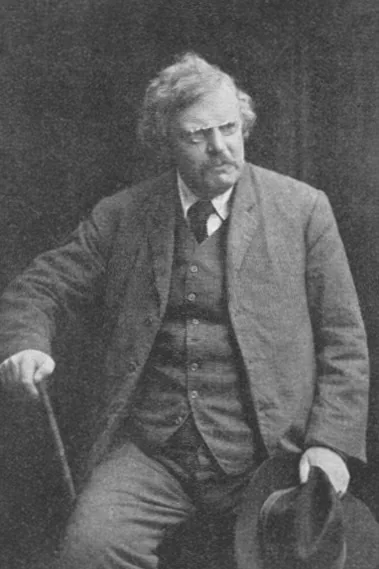
Father Brown has a real-life model. In 1904 Chesterton was lecturing in Keighley, Yorkshire, where he met a young Irish-born priest, Fr. John O’Connor. On a walk across the moors Chesterton was startled to discover how much this gentle cleric knew about human wickedness: O’Connor spoke frankly about crimes and vices that Chesterton, for all his worldliness, had never imagined. Shortly afterwards the two men met a pair of Cambridge undergraduates, who, once the priest had left the room, remarked condescendingly that it must be a pity for clergy to be so sheltered from the real evils of the world.
Chesterton, as he tells it in his Autobiography, nearly laughed aloud. The undergraduates knew far less about evil than the priest. Out of that comedy he conceived the idea of a detective who would appear completely innocent and harmless — and who would solve crimes precisely because hearing confessions had taught him everything about the human heart. Fr. O’Connor remained Chesterton’s friend for life and received him into the Catholic Church in 1922.
The five collections
Chesterton wrote some fifty Father Brown stories over a quarter of a century. They are gathered in five books:
| Collection | Year | Stories to start with |
|---|---|---|
| The Innocence of Father Brown | 1911 | “The Blue Cross”, “The Invisible Man”, “The Hammer of God”, “The Queer Feet”, “The Sign of the Broken Sword” |
| The Wisdom of Father Brown | 1914 | “The Absence of Mr Glass”, “The Paradise of Thieves”, “The Duel of Dr Hirsch” |
| The Incredulity of Father Brown | 1926 | “The Oracle of the Dog”, “The Miracle of Moon Crescent” |
| The Secret of Father Brown | 1927 | “The Secret of Father Brown” (the frame story) |
| The Scandal of Father Brown | 1935 | “The Point of a Pin”, “The Insoluble Problem” |
The first collection is the best place to begin, and “The Blue Cross” the best first story; but nearly any of them can be read in a single sitting, which is part of their charm.
The secret of Father Brown
Sherlock Holmes solves crimes by observation and deduction: the mud on a boot, the tan on a wrist. Father Brown notices physical clues too, but his real method is moral imagination. In the frame story “The Secret of Father Brown” (1927) he explains to an astonished American that he solves murders because he has, in a sense, committed them himself: he thinks and feels his way into the mind of the murderer until he knows exactly what kind of man would do such a thing — and realises that he himself is that kind of man, saved only by grace.
This is a profoundly Christian idea of detection. Father Brown does not see criminals as monsters or specimens; he sees them as sinners like himself, and his aim is not only to expose them but to save them. In several stories he lets the guilty party go, or hears a confession instead of calling the police. The great example is Flambeau, the thief of “The Blue Cross”, who is converted over the course of the early stories and becomes Father Brown’s closest friend and fellow investigator.
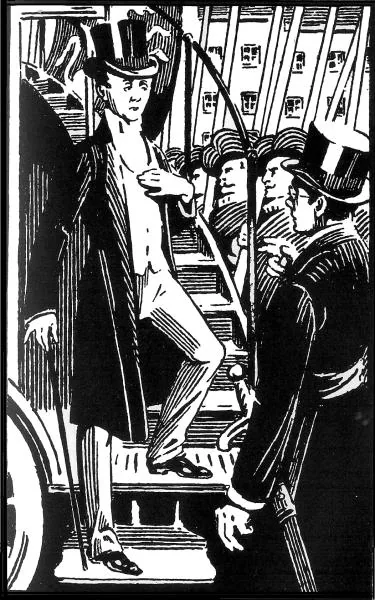
“You attacked reason. It’s bad theology.”
The single most famous line in the Father Brown canon comes at the climax of “The Blue Cross”. Flambeau, disguised as a priest, has tried to steal a precious cross by talking theology to Father Brown on Hampstead Heath. He is caught out when he sneers at reason. As Father Brown explains: “You attacked reason. It’s bad theology.”
The line sums up something essential in Chesterton. Against both the sceptics who said religion was irrational and the occultists who said reason was a cage, he insisted that Christianity is the great defender of reason. Again and again in the stories, the apparently supernatural turns out to have a natural explanation — and it is the priest, not the scientist or the spiritualist, who insists on finding it. Father Brown believes in miracles; that is precisely why he refuses to be fooled by fake ones.
Chesterton and the golden age
Chesterton took detective fiction seriously long before it was respectable. In “A Defence of Detective Stories”, published in The Defendant (1901), he argued that the detective story was the first popular literature to find poetry in the modern city — to see London as a place of romance, where every lamp-post and chimney-pot might be a clue.
When the Detection Club was founded in London in 1930 by Anthony Berkeley and other leading writers of mystery fiction, Chesterton was elected its first President, an office he held until his death. Members included Agatha Christie, Dorothy L. Sayers, Ronald Knox and Freeman Wills Crofts. The club’s new members swore a comic oath to play fair with their readers and not rely on “Divine Revelation, Feminine Intuition, Mumbo Jumbo, Jiggery-Pokery, Coincidence, or Act of God”. Chesterton contributed the prologue to the club’s round-robin novel The Floating Admiral (1931).
His influence on the genre was immense. The impossible crime, the clue hidden in plain sight, the twist that reverses our whole understanding of a scene — these became staples of golden-age fiction, and writers from John Dickson Carr to Jorge Luis Borges acknowledged Father Brown as a model.
Father Brown on screen
The little priest has been filmed many times. Alec Guinness played him in Father Brown (1954); while filming in France, Guinness was mistaken for a real priest by a small boy who took his hand and walked with him — an encounter Guinness later counted among the influences that led him into the Catholic Church in 1956. Kenneth More starred in an ITV series in 1974, and since 2013 Mark Williams has played the role in the long-running BBC series, which moves the stories to a 1950s Cotswold village.
Whodunnit? in Rochester
Our sixteenth conference, Whodunnit? GK Chesterton and the origins of detective fiction (28 September 2019), was devoted to these stories. Joseph Pearce, Dale Ahlquist and Kevin O’Brien spoke, and the Flying Inn Players gave a readers’-theatre performance of “The Blue Cross”. All of it can be watched on our recordings page.
If you have never read Father Brown, there is no better introduction to Chesterton: short, funny, surprising, and quietly profound. Start with “The Blue Cross” tonight — and bring your theories to our next monthly meeting.