The theme of our eighteenth Fr. Leo Hetzler Conference, held at St. John Fisher College on 12 November 2022, was Faith of Our Fathers: England and the Church. It took its title from Frederick William Faber’s hymn of 1849 — a hymn written by an English convert, in the very decade when the Catholic Church was re-emerging into English public life after three centuries of persecution. This article traces the story our speakers told: of a Catholic England that built Westminster Abbey and walked to Canterbury, of a Reformation that tore that world down, and of the literary converts — Newman, Chesterton and many others — who found their way back to it.
A hymn and a homecoming
Faber (1814–1863) was an Anglican clergyman who followed John Henry Newman into the Catholic Church in 1845 and later founded the London Oratory. His hymn looks back to the English martyrs of the sixteenth and seventeenth centuries — men and women who “in spite of dungeon, fire and sword” kept the old faith — and forward to a time when England might return to it. Sung today in parishes from Rochester to Melbourne, it carries a peculiarly English memory: the sense that Catholicism in England is not a foreign import but a family inheritance that was taken away.
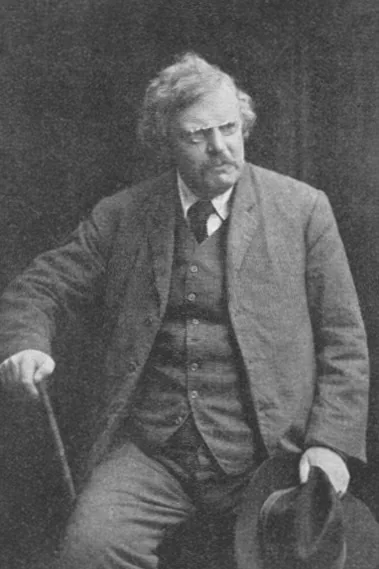
Chesterton felt that sense of inheritance keenly. For him, becoming a Catholic in 1922 was not leaving England but finding it. “The Catholic Church,” he wrote in another context, is “the only thing that frees a man from the degrading slavery of being a child of his age.” To be received into the Church was to join the England of Alfred, Becket, Chaucer and More.
The England of the abbeys
Medieval England was so thoroughly Catholic that it was known throughout Christendom as the Dowry of Mary. Its landscape was shaped by the Church: the great Benedictine abbeys and cathedral priories, the friaries in every market town, the parish churches whose towers still dominate English villages, and the shrines that drew pilgrims from across Europe — Our Lady of Walsingham in Norfolk, and St. Thomas Becket at Canterbury, murdered in his own cathedral in 1170.
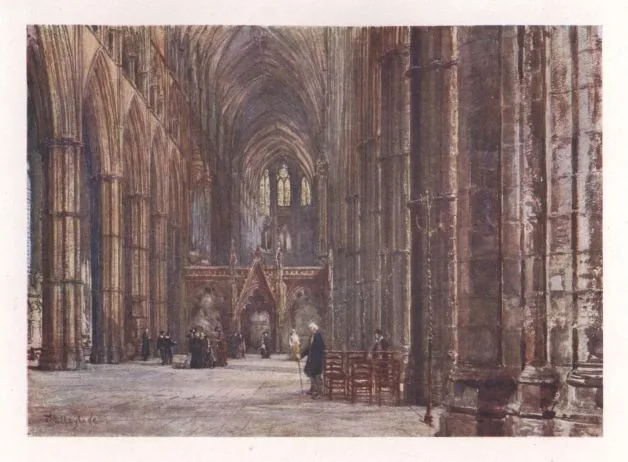
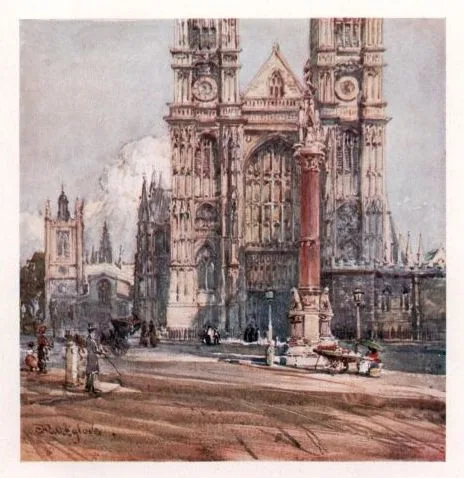
Westminster Abbey is the supreme monument of that world. Edward the Confessor rebuilt the Benedictine abbey on Thorney Island beside the Thames, and it was consecrated on 28 December 1065, only days before his death. Henry III rebuilt it again in the Gothic style from 1245, largely to honour the Confessor, whose shrine still stands behind the high altar. Every English coronation since 1066 has taken place there.
Chesterton loved this England not out of antiquarian nostalgia but because he believed it had got something right: it had held together faith, work, festivity and community. The guilds regulated trades for the good of their members; the monasteries fed the poor and taught the young; the calendar was punctuated by holy days that were also holidays. In A Short History of England (1917) he argued that the medieval period, for all its brutality, had been moving toward a society of free and property-owning ordinary people — a movement that was broken off.
Chaucer and the road to Canterbury
No writer embodies that world better than Geoffrey Chaucer, and Chesterton wrote a whole book about him in 1932. The Canterbury Tales gathers a knight, a miller, a prioress, a cook, a ploughman and a dozen others on the road to Becket’s shrine, and lets each of them speak in his or her own voice. Chesterton saw in this crowded, comic, quarrelling pilgrimage a picture of Christendom itself: a company of very different people, many of them sinners, going together to the same holy place.
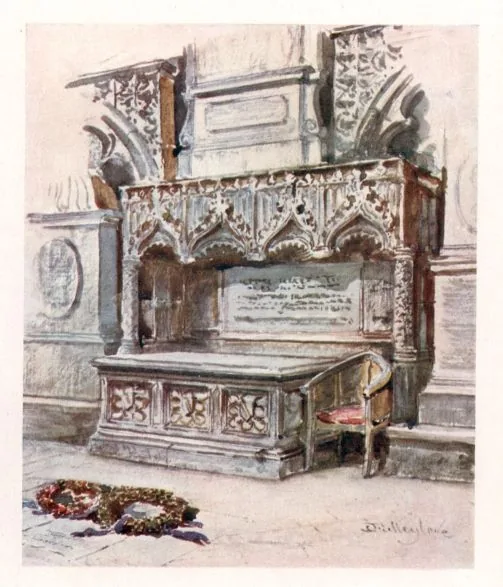
Chaucer was the first poet buried in what became Poets’ Corner in Westminster Abbey, in 1400. It is a fitting resting place for the father of English literature, and a reminder that English poetry was born Catholic.
The great pillage
Between 1536 and 1541, Henry VIII’s government dissolved every monastery, priory, friary and convent in England and Wales — some eight hundred houses. Their lands were sold or granted to the Crown’s supporters; their libraries were scattered, their shrines (Becket’s and Walsingham’s included) destroyed, their buildings quarried for stone. Westminster survived only because it was converted into a cathedral and later a “royal peculiar”.
Chesterton’s reading of this history owed much to the radical journalist William Cobbett, whose History of the Protestant Reformation (1824–26) argued that the Reformation in England had been above all a transfer of wealth from the poor to the rich. In his short biography of Cobbett (1925) and in A Short History of England, Chesterton took up this argument: the destruction of the monasteries created a new aristocracy of landowners, and the ordinary English labourer lost the protection and charity that the old religious houses had provided. Whatever one thinks of the economics, the human picture is vivid — and it explains why Chesterton thought of the English poor as a disinherited people.
His poem “The Secret People” gives that people a voice. It ends with a warning that still echoes:
Smile at us, pay us, pass us; but do not quite forget;
For we are the people of England, that never have spoken yet.— G. K. Chesterton, “The Secret People”
Newman and the Second Spring
For nearly three centuries English Catholics lived as a small and often persecuted minority. The penal laws were gradually relaxed in the late eighteenth century, and the Catholic Emancipation Act of 1829 finally allowed Catholics to sit in Parliament. In 1850 Pope Pius IX restored the Catholic hierarchy of bishops in England and Wales.
Into this moment stepped John Henry Newman (1801–1890), the most brilliant Anglican of his generation and a leader of the Oxford Movement. After years of study of the early Church, Newman was received into the Catholic Church by the Passionist Blessed Dominic Barberi at Littlemore, near Oxford, on 9 October 1845. His conversion shocked England. In 1852 he preached a sermon called “The Second Spring” at the first synod of the restored hierarchy, comparing the return of the Church to the coming of spring after a long winter. Newman was declared a saint by Pope Francis in 2019. Our 2007 conference, Conversion of Heart, was devoted to Newman, Chesterton, St. Paul and St. Augustine.
A literary revival
Newman opened a door through which an extraordinary number of English writers followed. The poet Gerard Manley Hopkins was received by Newman himself in 1866. Robert Hugh Benson, son of an Archbishop of Canterbury, converted in 1903 and became a bestselling novelist; Ronald Knox, son of an Anglican bishop, followed in 1917 and became a celebrated translator, preacher and writer of detective stories. Chesterton came in 1922, Graham Greene in 1926, Evelyn Waugh in 1930; Muriel Spark and Siegfried Sassoon later still.
Joseph Pearce, who has spoken at almost every one of our conferences, has told this story in his book Literary Converts (1999). What united these writers was not a single temperament — Waugh and Chesterton could hardly have been more different — but a common discovery: that the faith of their fathers was intellectually serious, culturally rich and, in Chesterton’s word, alive. Our 2013 conference heard Rev. Nathan Allen on Benson and Knox.
The Ballad of the White Horse
Chesterton’s most ambitious poem, The Ballad of the White Horse (1911), is set long before the Reformation, in the dark year 878 when King Alfred of Wessex was a fugitive from the Danes. In Chesterton’s telling, Alfred receives a vision of the Virgin Mary who gives him no promise of victory — only the command to fight on:
I tell you naught for your comfort,
Yea, naught for your desire,
Save that the sky grows darker yet
And the sea rises higher.— The Ballad of the White Horse, Book I
Alfred gathers his scattered allies and wins the battle of Ethandune. The poem is about the survival of a Christian civilisation against overwhelming odds, and it was read aloud and memorised by soldiers in both World Wars. It is perhaps the best single expression of what “faith of our fathers” meant to Chesterton: not a comfortable heritage, but a costly fidelity handed down from those who fought for it.
Why this history matters in Rochester
It may seem a long way from Westminster to East Avenue. But the story of English Catholicism is part of the inheritance of every English-speaking Christian, and the questions Chesterton asked of it — what a culture loses when it forgets its spiritual roots, and what it takes to recover them — are our questions too. The talks from our 2022 conference by Joseph Pearce, Dale Ahlquist, Ted Janiszewski and Fr. Peter Mottola are all free to watch.